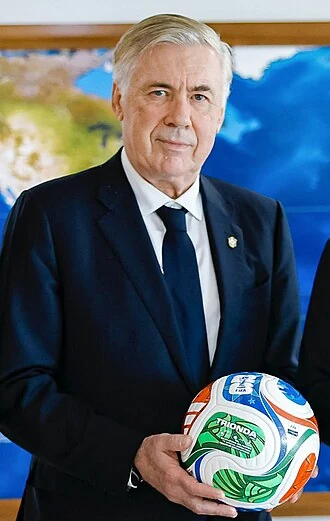
The date matters here. On March 17, 2026, Brazil is coached by Carlo Ancelotti, not Dorival Junior. Dorival was appointed in January 2024 and dismissed on March 28, 2025, before CBF formally announced Ancelotti on May 12, 2025.
That does not make Dorival irrelevant. His spell still explains a lot about why Brazil felt stuck in the middle of the cycle and why the federation decided the biggest matches of 2026 needed a different tactical voice.
Dorival's Brazil pointed toward a back-four structure with more central protection, calmer buildup, and clearer support for the wide attackers. The intention was to make the team less chaotic and more trustworthy between the boxes.
The problem was that the idea never became convincing enough. Brazil still looked too dependent on individual quality, and the wider structure did not settle into the kind of complete tournament model the federation wanted.
Early Life and Coaching Career
Background and playing career
Dorival Junior was born on April 25, 1962, and spent his playing career in Brazilian football before becoming one of the country's best-known domestic coaches. His coaching reputation was built on calm man-management and a strong feel for squad balance.
That domestic experience is what made him relevant to Brazil's 2026 cycle in the first place.
Coaching career start and progression
He coached a long list of major Brazilian clubs, including Santos, Flamengo, Sao Paulo, and Corinthians, winning major domestic and continental honours along the way. The national team job arrived after he had re-established himself as a proven club winner.
Dorival Junior at Brazil
How he was appointed
Brazil appointed Dorival in January 2024 because the federation wanted a calmer bridge into the next phase of the cycle and hoped he could stabilise the midfield shape around the attacking talent.
Results, achievements, and current standing
As of March 17, 2026, Dorival is not Brazil's live World Cup coach. Brazil moved on from his spell in March 2025, which means his role in the 2026 story is now best read as an important but unfinished bridge phase.
Tactical Style and Formation
Preferred system and how the team plays under him
Between January 2024 and March 2025, Dorival tried to give Brazil a more measured identity. He was not looking for a radical revolution. He was looking for cleaner spacing, more reliable midfield distances, and less emotional volatility once the team lost the ball.
That made sense after the instability that came before him. Brazil did not need less talent. It needed more order. The difficulty was that the structure often looked like a work in progress rather than a finished high-end national-team system.
Without the ball, Brazil often looked closer to a 4-1-4-1 or 4-5-1 shape, with the midfield asked to protect the centre and delay transitions before the back line got exposed. That was a clear attempt to make the team less easy to counter through the middle.
Marquinhos mattered a lot in that plan because the line needed a defender who could manage depth, cover wide spaces, and keep the back four calm when the press broke in front of it.
With the ball, the structure often pointed toward a 4-3-3 or 4-2-3-1 base. The build-up aimed to create enough security underneath the play so the wide attackers could receive in better conditions instead of constantly trying to rescue bad spacing on their own.
Rodrygo was important to that idea because he could connect short combinations, drift between lines, and still attack the last line once the move opened up. The wider issue was that Brazil did not always turn those promising positions into repeatable attacking control.
World Cup 2026 Plan
Squad approach, key selections, and tournament goals
Dorival's cycle was really about support structure. The talent at the top end of the squad was never the question. The question was whether the midfield and back line could give that talent a platform that felt stable enough against elite opponents.
When the support around the attack looked slightly loose, Brazil slipped back into a familiar pattern: dangerous in moments, but not fully convincing as a complete team. That is the core tactical story of his spell.
For 2026, Dorival is part of the backstory rather than the live answer. His cycle helps explain why Brazil eventually chose a bigger reset and moved toward Ancelotti for the final World Cup phase.
That is why this page still matters. It shows the tactical problems Brazil was trying to solve, even if Dorival was not the coach who got the last chance to solve them.
Personal Info
| Full name | Dorival Junior |
|---|---|
| Date of birth | April 25, 1962 |
| Age | 63 |
| Nationality | Brazil |
| Current team | Corinthians |
| Contract until | yet to be confirmed |
| Coaching style | Balance-first structure with controlled attacking width |
| Major honors | Copa Libertadores 2022, Copa do Brasil 2022 and 2023 |
Salary and Net Worth
Earnings and estimated net worth
Strong public reporting on the exact value of his Brazil deal never settled into one reliable figure before his exit from the role.
Will be updated soon.
Frequently Asked Questions
Dorival Junior is the coach profiled here through the lens of Brazil and the World Cup 2026 cycle.
Balance-first structure with controlled attacking width
yet to be confirmed
The goal of his Brazil spell was to reduce chaos, improve balance, and give the team a more reliable tournament platform.
Conclusion
Dorival Junior was not Brazil's final 2026 answer, but his spell remains important because it showed exactly where the team still felt incomplete.
His tactical story is best read as a bridge phase: sensible in parts, unfinished in practice, and central to understanding why Brazil later chose a bigger coaching reset.