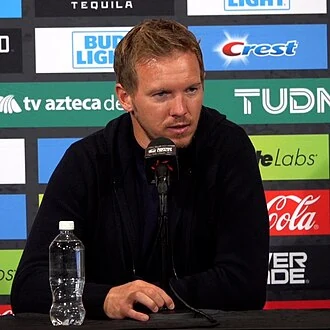
Germany made a clear long-term call when the DFB extended Julian Nagelsmann on 24 January 2025 through EURO 2028. That decision came before the World Cup itself, which tells you how strongly the federation believes his tactical reset is the right one.
The bigger question is how far that reset can take Germany in World Cup matches. Nagelsmann has added intensity and movement, but the final test is whether the structure can stay balanced against the best counterattacking teams.
Nagelsmann wants Germany to be more aggressive in the press, more flexible in buildup, and less predictable around the box. The side often starts from a 4-2-3-1 or 4-3-3 look, but the shape shifts quickly as midfielders and full-backs move inside or forward.
That gives Germany a high ceiling because the team can overload central areas and attack the half-spaces well. The risk is that the same ambition can open transition lanes if the rest defence is not set.
Overview of Germany's Tactical Shape
Germany under Nagelsmann does not want sterile control. It wants control with pressure behind it. The team tries to move the opponent, press immediately after turnovers, and create attacking waves instead of isolated actions.
This is why the side now feels more modern than in some earlier cycles. The system is not only about keeping the ball. It is about making every phase point toward the next advantage.
How Germany Uses This System
Defensive shape and structure
Without the ball, Germany is more front-footed than many traditional tournament teams. The line of confrontation often starts high, with the forwards and attacking midfielders trying to force rushed decisions early in the buildup.
That approach can be powerful when the distances behind the press stay right. If the midfield gets stretched, though, the opponent can attack the space left behind the first wave.
Attacking patterns and transitions
In attack, Germany wants fluid movement around the final third. The rotations between the No. 10 zone, the wide lanes, and the full-backs are meant to disorganize defenders rather than let them hold static references.
That is one reason Florian Wirtz matters so much. He can receive between lines, carry into pressure, and speed up the final action in ways that turn a good move into a dangerous one.
Key players and their roles
Germany's tactical success depends on the links between the playmakers and the structure behind them. If the deeper midfield and centre-backs manage the rest defence well, the attacking players get much more freedom to interchange.
Nagelsmann also wants bravery from his wide and support players. The side looks best when several runners threaten the same move, because that makes the press and the attacking patterns feel connected rather than separate.
Strengths of This Approach
The biggest strength of Nagelsmann's Germany is ceiling. When the press works and the attacking rotations land cleanly, the team can overwhelm opponents very quickly.
Germany also has a more flexible tactical profile than before. It can shift shape during the match without looking lost, which is a major plus in knockout football.
Weaknesses and Vulnerabilities
The weakness is the usual one for ambitious pressing teams: control behind the first line. If the ball gets played through too easily, the defensive line can be left protecting too much space.
There is also a trust question under heavy pressure. Germany has improved, but the World Cup will test whether the team can stay calm when the game stops flowing in its direction.
How It Could Play Out at World Cup 2026
Germany should arrive at World Cup 2026 as one of the more dangerous high-ceiling teams because Nagelsmann has given it tactical modernity and sharper intensity. That combination can win major matches.
If the rest defence holds and the creative players keep finding rhythm, Germany has a real path to a deep run rather than just outsider status.
Frequently Asked Questions
Germany often starts from a 4-2-3-1 or 4-3-3, with shape changes during buildup and pressure phases.
He is making Germany more aggressive in the press and more fluid in the final third.
Because he helps Germany receive between lines and turn possession into direct attacking danger.
The main risk is transition exposure if the press is broken and the rest defence is not set.
Conclusion
Nagelsmann has given Germany a clearer modern identity and a higher tactical ceiling than the team had in its weaker recent cycles.
Now the key question is not whether Germany looks improved. It is whether that improvement is strong enough to survive six or seven World Cup games.