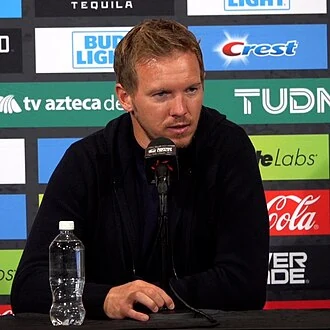

Germany made a clear long-term call when the DFB extended Julian Nagelsmann on 24 January 2025 through EURO 2028. That decision came before the World Cup itself, which tells you how strongly the federation believes his tactical reset is the right one.
The bigger question is how far that reset can take Germany in World Cup matches. Nagelsmann has added intensity and movement, but the final test is whether the structure can stay balanced against the best counterattacking teams.
Nagelsmann wants Germany to be more aggressive in the press, more flexible in buildup, and less predictable around the box. The side often starts from a 4-2-3-1 or 4-3-3 look, but the shape shifts quickly as midfielders and full-backs move inside or forward.
That gives Germany a high ceiling because the team can overload central areas and attack the half-spaces well. The risk is that the same ambition can open transition lanes if the rest defence is not set.
Early Life and Coaching Career
Background and playing career
Julian Nagelsmann was born on July 23, 1987, and moved into coaching very early after injury ended his playing path. That unusual start helps explain why he is known first for tactical detail, structural thinking, and problem-solving.
He is one of the clearest examples of a modern coach shaped more by ideas and training-ground work than by long elite playing fame.
Coaching career start and progression
Nagelsmann built his profile at Hoffenheim, RB Leipzig, and Bayern Munich before Germany appointed him in 2023. His rise was rapid, but it came with enough elite-club experience to make him credible in one of international football's biggest jobs.
Julian Nagelsmann at Germany
How he was appointed
The DFB appointed Nagelsmann in September 2023 and later extended him through 2028 because Germany wanted a younger coach with a more aggressive, modern tactical vision.
Results, achievements, and current standing
As of March 17, 2026, Nagelsmann is still Germany's coach and one of the main reasons the team again feels like a genuine contender rather than just a famous name.
Tactical Style and Formation
Preferred system and how the team plays under him
Germany under Nagelsmann does not want sterile control. It wants control with pressure behind it. The team tries to move the opponent, press immediately after turnovers, and create attacking waves instead of isolated actions.
This is why the side now feels more modern than in some earlier cycles. The system is not only about keeping the ball. It is about making every phase point toward the
Without the ball, Germany is more front-footed than many traditional tournament teams. The line of confrontation often starts high, with the forwards and attacking midfielders trying to force rushed decisions early in the buildup.
That approach can be powerful when the distances behind the press stay right. If the midfield gets stretched, though, the opponent can attack the space left behind the first wave.
In attack, Germany wants fluid movement around the final third. The rotations between the No. 10 zone, the wide lanes, and the full-backs are meant to disorganize defenders rather than let them hold static references.
That is one reason Florian Wirtz matters so much. He can receive between lines, carry into pressure, and speed up the final action in ways that turn a good move into a dangerous one.
World Cup 2026 Plan
Squad approach, key selections, and tournament goals
Germany's tactical success depends on the links between the playmakers and the structure behind them. If the deeper midfield and centre-backs manage the rest defence well, the attacking players get much more freedom to interchange.
Nagelsmann also wants bravery from his wide and support players. The side looks best when several runners threaten the same move, because that makes the press and the attacking patterns feel connected rather than separate.
Germany should arrive at World Cup 2026 as one of the more dangerous high-ceiling teams because Nagelsmann has given it tactical modernity and sharper intensity. That combination can win major matches.
If the rest defence holds and the creative players keep finding rhythm, Germany has a real path to a deep run rather than just outsider status.
Personal Info
| Full name | Julian Nagelsmann |
|---|---|
| Date of birth | July 23, 1987 |
| Age | 38 |
| Nationality | Germany |
| Current team | Germany |
| Contract until | 2028 |
| Coaching style | Flexible high press and vertical play |
| Major honors | Bundesliga 2021-22 |
Salary and Net Worth
Earnings and estimated net worth
Recent 2025-26 salary rankings place his Germany pay at around EUR 4.8 million per year, putting him among the best-paid international coaches in the game.
Net worth: Will be updated soon.
Frequently Asked Questions
Julian Nagelsmann is the coach profiled here through the lens of Germany and the World Cup 2026 cycle.
Flexible high press and vertical play
2028
The goal is to keep Germany brave, vertical, and tactically clear enough to turn its talent into another deep World Cup run.
Conclusion
Nagelsmann has given Germany a clearer modern identity and a higher tactical ceiling than the team had in its weaker recent cycles.
Now the key question is not whether Germany looks improved. It is whether that improvement is strong enough to survive six or seven World Cup games.